20251228_TheTibetanBookOfLiving&Dying_pen
20260301_TheMountain,TheMoonCave&TheSadGod_pen
20240515_WhenBreathBecomesAir_pen
Palliative / Hospice Care | Jeevodaya |
Inspired from this book?
https://share.google/iAYGXYzlIeUghPhh8
A near-death experience makes us understand the separation between life and death.
Is spiritual guidance necessary to prepare for a good death, and a way to truly realize the meaning of our lives?
Based on and expanded upon the work in The Bardo Thodol, aka The Tibetan Book of the Dead.
It is a terma text from a larger corpus of teachings, the Profound Dharma of Self-Liberation through the Intention of the Peaceful and Wrathful Ones.
Bardo (Tibetan) - Antarābhava (Sanskrit)
Antarā means 'between', and
bhava means 'a place of existence'. Hence, bardo means 'an existence between'.
Bardos; a series of intermediate states between death and rebirth which denote our entire life and death as a sequence.
They are charged moments when the possibility of enlightenment or realisation is heightened.
The four bardos of living and dying are;
- The natural bardo of living
- The painful barso of dying
- The luminous bardo of sharmata
- The karmic bardo of becoming
Living
Chapter 1: In the Mirror of Death
Chapter 2: Impermanence
There are only 2 sureties;
- all of us will die one day.
- no one knows when and how they will die.
The uncertainty of the hour of death is the reason why life is so fragile, so vulnerable to the effects of Samsara.
The topic of death, in this case, shouldn't be avoided just because it is quite unknown about what lies after death.
The current dominant idea is that an afterlife may not exist, hence it is meaningless to safeguard the legacy of our lives.
If this were the approach of all humans, then we'll end up living a life where we make both living and dying intolerable for the future generations.
Being caught up in experiencing our short-term pleasures, we are forsaking the pursuit of the true meaning of life and death.
The realisation of impermanence may be the only thing that is permanent in our lives.
!IMG_20260220_084104801 (1).jpg
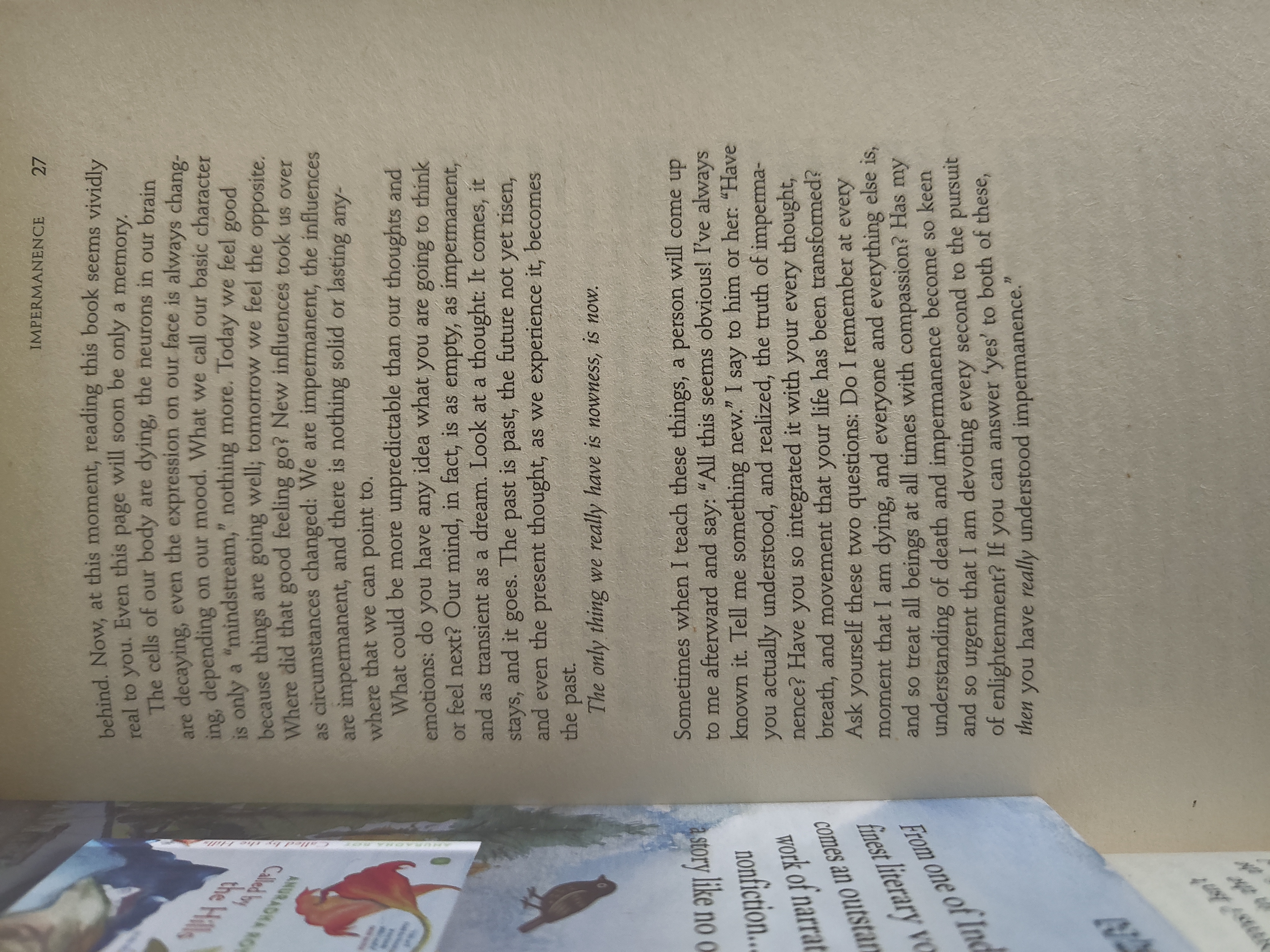
The only thing we really have is nowness, is now.
Chapter 3: Reflection and Change
Contemplating on death leads to a change in the depths of the heart. The following effects can be observed;
- an increased capacity of love,
- the urge to help people in need,
- a deeper acceptance of death,
- reduced fear of death,
- the pursuit of a meaningful life,
- and a growing belief in a spiritual dimension beyond life and death.
Learning to live is learning to let go.
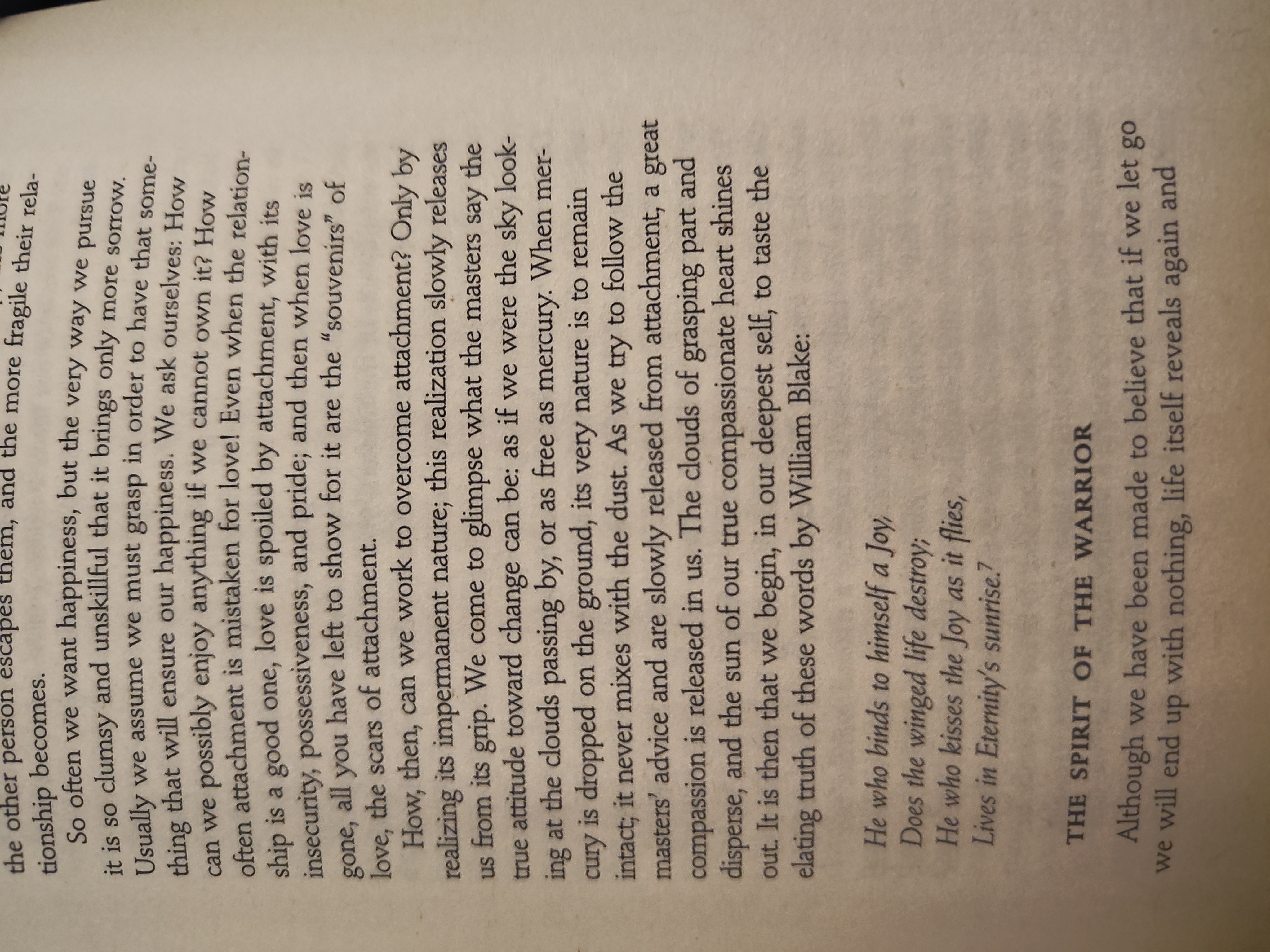
Accepting impermanence lets us see that everything in the universe is empty, meaning it does not hold an independent existence, only an interconnected one.
- Like a wave in the ocean, which is merely a behaviour of water caused by gravity and wind, dependent on a variable set of conditions. A wave is related to every other wave and does not exist on its own. The wave is only a part of the water. A wave is the very nature of the ocean. It comes from the ocean and goes back to it.
- Like a tree; it does not exist without the presence of the rain that provides it nourishment, the soil that provides the foundation for it to grow, the sunlight that is essential for its growth, etc. There are many things which influence the existence of a tree, which are in turn connected to other things.
Chapter 4: The Nature of Mind
'What is mind?'
This question alone is enough to make one realise that there is so such thing in nature as the mind.
It is one that we create by becoming possessed by the past and focusing on the future.
It makes us unaware of the moment, of the reality in front of us.
But once we open ourselves to the unending depth and nature of the mind, we can then experience the nowness.
[Yi yi ; we can only see half of the truth, not what's behind us, around hs]
Life and Death are in the mind.
The mind is both the creator of happiness and suffering.
To realize the nature of mind is to realize the nature of all things.
The budda nature, the enlightenment in which we collapse the walls between the ordinary mind and the innermost nature of the mind, is accessible to everyone.
It is very difficult in this day and age since our ordinary minds are so wrapped up in confusion with all of our thoughts and desires.
If the Buddha nature of the mind is the sky, then it is covered up with our individual clouds.
Chapter 5: Bringing the Mind Home
Meditation is the road to enlightenment.
It is the prolonging of the gap between when the past thought has ceased and the future thought hasn't yet risen.
-
The Good in the Beginning; the skillful motivation for meditation, the heart of true practice.
The Good in the Beginning is the awareness that realizing our innermost nature will lead to the end of our suffering. -
The Good in the Middle; the attitude of non-grasping that secures the meditation, the eye of true practice.
The Good in the Middle is the realization that reality is illusory and dream-like and there is no point in grasping to ideals or concepts. -
The Good in the End; the dedication to all beings that seals the meditation, the life force of true practice.
The Good in the End is about dedicating the merits of meditation to the liberation of all beings and peace for the whole world.
A big part of meditation is the practice of mindfulness; being aware of every moment, is known as 'Peacefully Remaining' or 'Calm Abiding'.
Shamantha in Sanskrit, shyinè in Tibetan.
This is the first step, removing the unkindness from our heart to reveal the Good Heart, the fundamental goodness and kindness which are our nature.
Meditation consists of 3 essential points;
- bring your mind home,
- release, and
- relax
The goal is to rest in natural great peace.
Your View and Your Posture
Your Posture should be like a mountain
Meditate with your eyes open.
(Pg 69)
This will let the mind slip into the nowness.
These three methods of meditation are particularly effective in today's age of chaos.
- Using an object
- Reciting a mantra,
- Watching the breath.
Breath is life, the most basic and fundamental expression of life.
However, Calm Abiding alone is not enough. It needs to be followed by Clear Seeing.
When the sky-like nature of our true being is revealed, you get the 'wisdom that realizes egolessness'.
Grasping of the self has been dissolved and we simply rest in the nature of mind.
Thoughts and emotions are like the wave and the ocean. We must allow them to rise and settle in our minds.
Thoughts are like the wind; the secret is to not think about them, but to let them flow through our mind.
20251106_Don'tBelieveEverythingYouThink_pen
Everything can be used as an invitation for meditation.
Whether we're sitting in our room or walking at the park, the subway or the lake, on top of a mountain or at the beach, inspiration can be found anywhere.
The goal is to embody the transcendant, to live the truth from moment-to-moment.
Chapter 6: Evolution, Karma and Rebirth
There is no objective way to disprove life after death.
The continuity of the mind is the main basis for the existence of rebirth.
The Dalai Lama states that the material plane is part of a continuum, where all living beings are the result of the particles of the universe forming and reforming in an endless cycle of change.
Similarly, if we trace the origin of the mind, we would find it to be a continuity.
This is the basis of the Buddist concept of rebirth.
Just as the material universe can be traced back to an origin where its elements were composed of the most basic units, aka space particles, the continuity of consciousness is composed of the Clear Light.
Karma
Karma is defined literally as action, the power latent within actions, and the results of the actions.
It is the natural law of cause and effect.
Every action we take, no matter how big or small, good or bad, has its consequences.
Tiny drops of oil can spoil an ocean, and sowing a single seed can lead to a garden of trees.
At times, the effects of our actions are delayed. But they will ripen over time.
Karma does not decay like matter. It continues across different people, multiple rebirths.
Because the actions of the past have defined the present, and the future is continuously shaped by what we do now.
The events of our lives are the results of many karmas mixing together, ripening at different times. Karma makes the most sense to explain our current circumstances, rather than luck or chance.
The Good Heart
Creativity
Responsibility
Reincarnation
Souls which have achieved spiritual realisation can choose to appear in life after life to help others.
Such realized masters leave hints of their potential reincarnation. The tradition of identifying such incarnations is called tulkus.
The concept of reincarnation is not limited to Tibet. Geniuses from every part of the world, such as Gandhi, Einstein, Abraham Lincoln, etc. are revered as bodhisattvas. Their work and vision moved like the emanation of the Buddhas, to liberate and better the whole world.
Chapter 7: Bardos and Other Realities
Bardo - Tibetan word for transition or gap between the completion of one event and the inception of another.