20251228_TheTibetanBookOfLiving&Dying_pen
20260301_TheMountain,TheMoonCave&TheSadGod_pen
20240515_WhenBreathBecomesAir_pen
Palliative / Hospice Care | Jeevodaya |
Inspired from this book?
https://share.google/iAYGXYzlIeUghPhh8
A near-death experience makes us understand the separation between life and death.
Is spiritual guidance necessary to prepare for a good death, and a way to truly realize the meaning of our lives?
Based on and expanded upon the work in The Bardo Thodol, aka The Tibetan Book of the Dead.
It is a terma text from a larger corpus of teachings, the Profound Dharma of Self-Liberation through the Intention of the Peaceful and Wrathful Ones.
Bardo (Tibetan) - Antarābhava (Sanskrit)
Antarā means 'between', and
bhava means 'a place of existence'. Hence, bardo means 'an existence between'.
Bardos; a series of intermediate states between death and rebirth which denote our entire life and death as a sequence.
They are charged moments when the possibility of enlightenment or realisation is heightened.
The four bardos of living and dying are;
- The natural bardo of living
- The painful barso of dying
- The luminous bardo of sharmata
- The karmic bardo of becoming
Living
Chapter 1: In the Mirror of Death
Chapter 2: Impermanence
There are only 2 sureties;
- all of us will die one day.
- no one knows when and how they will die.
The uncertainty of the hour of death is the reason why life is so fragile, so vulnerable to the effects of Samsara.
The topic of death, in this case, shouldn't be avoided just because it is quite unknown about what lies after death.
The current dominant idea is that an afterlife may not exist, hence it is meaningless to safeguard the legacy of our lives.
If this were the approach of all humans, then we'll end up living a life where we make both living and dying intolerable for the future generations.
Being caught up in experiencing our short-term pleasures, we are forsaking the pursuit of the the true meaning of life and death.
The realisation of impermanence may be the only thing that is permanent in our lives.
!IMG_20260220_084104801 (1).jpg
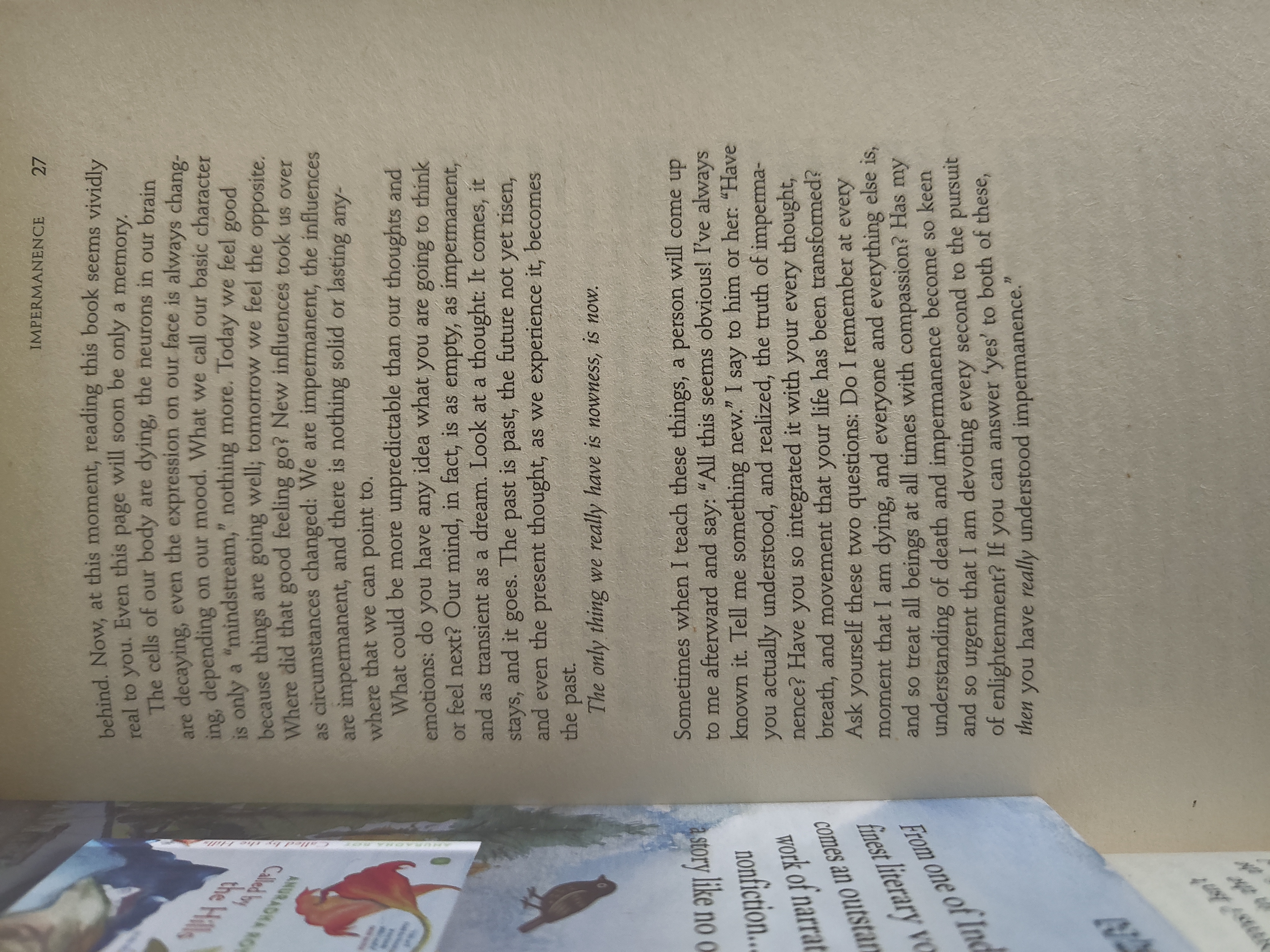
The only thing we really have is nowness, is now.
Chapter 3: Reflection and Change
Contemplating on death leads to a change in the depths of the heart. The following effects can be observed;
- an increased capacity of love,
- the urge to help people in need,
- a deeper acceptance of death,
- reduced fear of death,
- the pursuit of a meaningful life,
- and a growing belief in a spiritual dimension beyond life and death.
Learning to live is learning to let go.
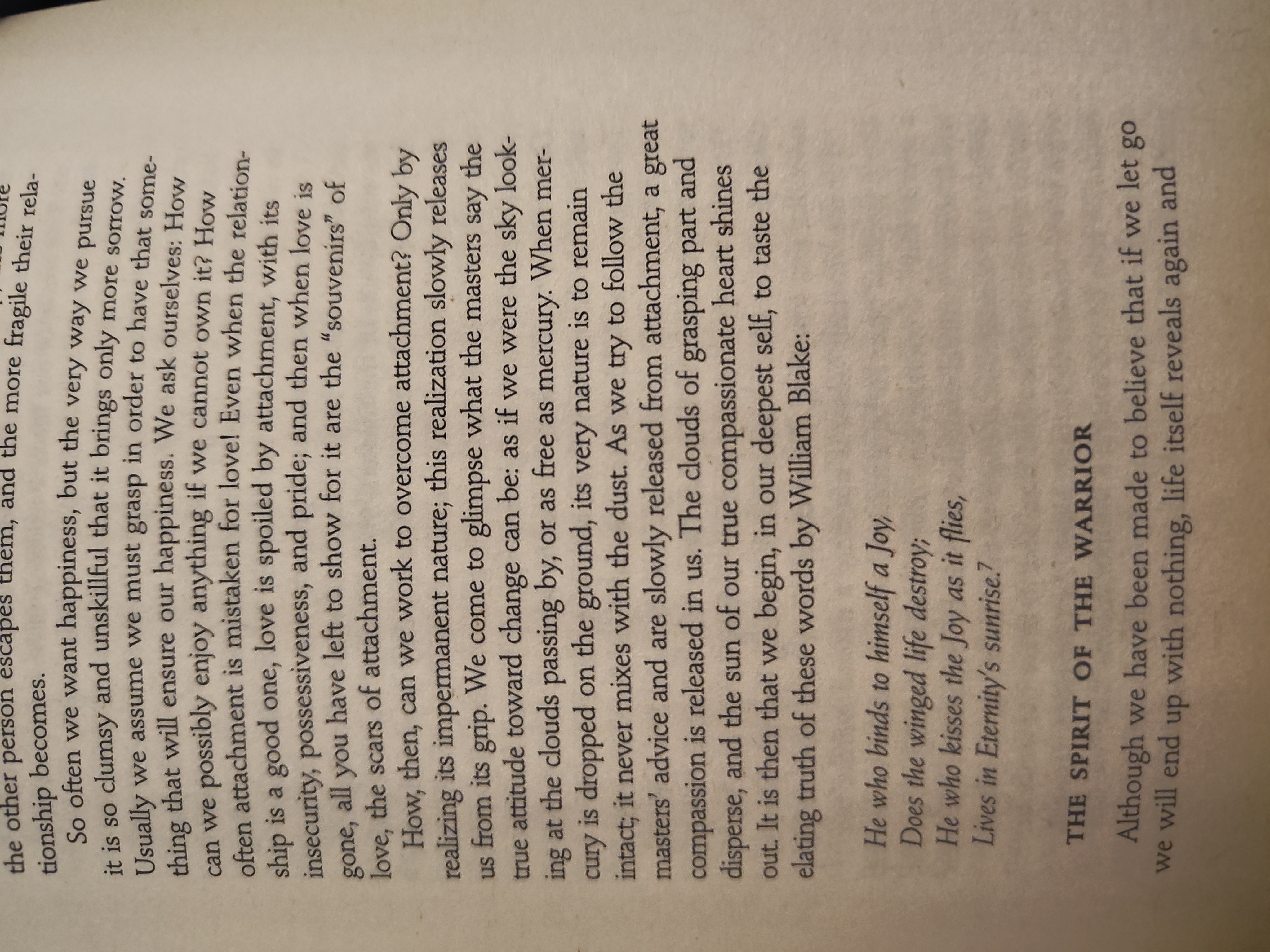
Accepting impermanence lets us see that everything in the universe is empty, meaning it does not hold an independent existence, only an interconnected one.
- Like a wave in the sea, which is merely a behaviour of water caused by gravity and wind, dependent on a variable set of conditions. A wave is related to every other wave and does not exist on its own.
- Like a tree; it does not exist without the presence of the rain that provides it nourishment, the soil that provides the foundation for it to grow, the sunlight that is essential for its growth, etc. There are many things which influence the existence of a tree, which are in turn connected to other things.
Chapter 4: The Nature of Mind
'What is mind?'
This question alone is enough to make one realise that there is so such thing in nature as the mind.
It is one that we create by becoming possessed by the past and focusing on the future.
It makes us unaware of the moment, of the reality in front of us.
But once we open ourselves to the unending depth and nature of the mind, we can then experience the nowness.
[Yi yi ; we can only see half of the truth, not what's behind us, around hs]
Life and Death are in the mind.
The mind is both the creator of happiness and suffering.
To realize the nature of mind is to realize the nature of all things.
The budda nature, the enlightenment in which we collapse the walls between the ordinary mind and the innermost nature of the mind, is accessible to everyone.
It is very difficult in this day and age since our ordinary minds are so wrapped up in confusion with all of our thoughts and desires.
If the Buddha nature of the mind is the sky, then it is covered up with our individual clouds.
Chapter 5: Bringing the Mind Home
Meditation is the road to enlightenment.
The Good in the Beginning
The Good in the Middle
The Good in the End
The practice of mindfulness; being aware of every moment, is known as 'Peacefully Remaining' or 'Calm Abiding'.
Shamantha in Sanskrit, shyinè in Tibetan.
This is the first step, removing the unkindness from our heart to reveal the Good Heart, the fundamental goodness and kindness which are our nature.
Meditation consists of 3 essential points;
- bring your mind home,
- release, and
- relax
The goal is to rest in natural great peace.
Your View and Your Posture
Your Posture should be like a mountain
Meditate with your eyes open.
(Pg 69)